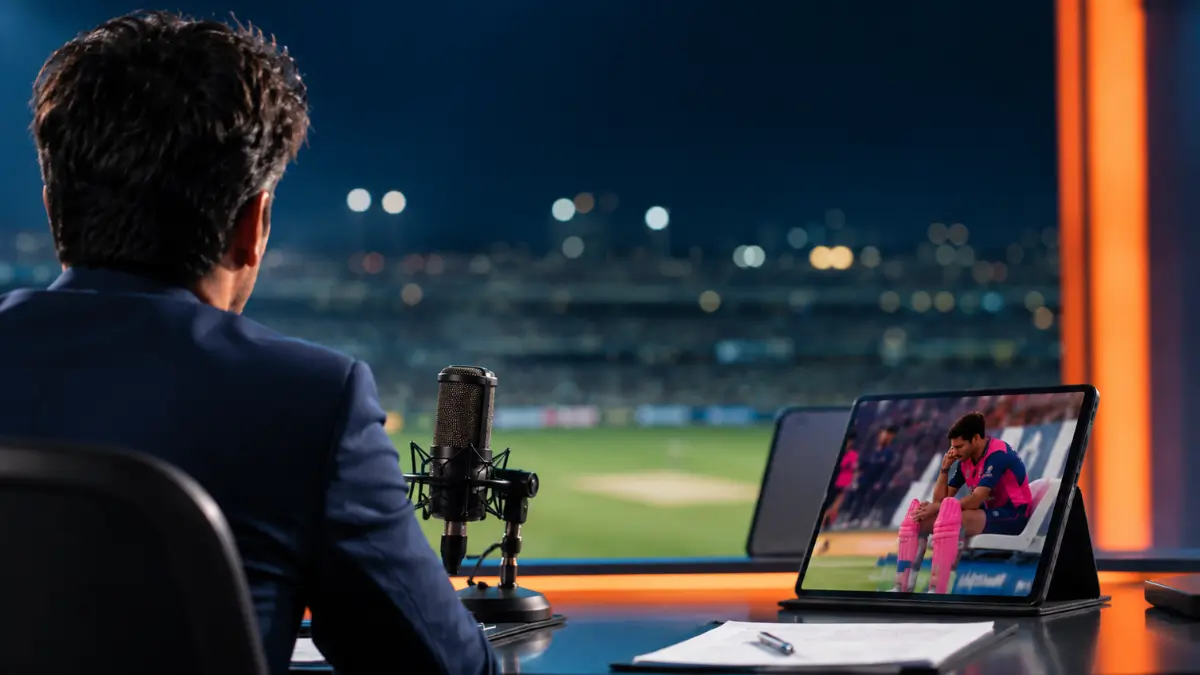
CRICKET • TEAM INDIA • SELECTION CONTROVERSY
He is fifteen years old. He is the youngest Orange Cap winner in Indian Premier League history. He has more sixes in one IPL season than Chris Gayle’s single sason record ever did. And when Team India needed him most on a seaming, two-paced Belfast pitch that eventually handed the T20 World Cup champions their first-ever series defeat to Ireland. Vaibhav Sooryavanshi did not bat a single ball. He did not even take the field. That single fact has now become the biggest talking point in Indian cricket, and former India batter Mohammad Kaif has put the selectors’ reasoning under a microscope that they may not enjoy sitting under.
Record That Made the Bench Look Absurd
To understand why the omission stings so much, you have to understand exactly what Sooryavanshi did in IPL 2026. Playing for Rajasthan Royals, Bihar born opener scored 776 runs in just 16 innings at an average of 48.50 and a strike rate of 237.3, it is the highest strike rate ever posted by a batter who finished on top of the run charts. He has scored 72 sixes across the season, obliterating the previous single season record of 59 that had stood since Chris Gayle’s imperious 2012 campaign. He reached 1,000 IPL runs faster, in terms of balls faced, than any player before him, breaking a record that had belonged to Andre Russell. He scored a 36-ball century, the third-fastest in IPL history, and he did all of this while still a schoolboy by age.
By the time the IPL 2026 final ended, Sooryavanshi had walked away with three separate honours: the Orange Cap for most runs, the tournament MVP award, and the Emerging Player of the Season award. This was th first time any in IPL history to win all three awards in a single edition. Legendary batter Sachin Tendulkar himself called the teenager’s technique “truly special,” pointing specifically to his wrist work and his ability to pick length earlier than anyone else in the format.
| Rank | Player | Team | Runs | Strike Rate |
|---|---|---|---|---|
| 1 | Vaibhav Sooryavanshi | Rajasthan Royals | 776 | 237.3 |
| 2 | Shubman Gill | Gujarat Titans | 732 | |
| 3 | Sai Sudharsan | Gujarat Titans | 722 | |
| 4 | Virat Kohli | Royal Challengers Bengaluru | 675 | 56.25 avg |
Ireland Tour: A Debut That Kept Getting Postponed
The scale of anticipation heading into India’s white-ball tour of Ireland was unlike anything a two-match T20I series against a lower-ranked side usually generates. Fans travelled from as far as Paris to Belfast’s Stormont Cricket Ground purely on the hope of watching a 15-year-old make his international debut. Ticket demand for the first T20I spiked so sharply that organisers reportedly scrambled to arrange extra temporary seating. Yet when the team sheet was read out, the reigning T20 World Cup champions stuck with their settled top order of Sanju Samson and Abhishek Sharma, with Ishan Kishan slotted in at number three. The exact core that had powered India’s World Cup triumph months earlier.
India lost that opener by 34 runs, their first defeat to Ireland in any format, as debutant pacer Jai Moondra and skipper Lorcan Tucker’s half-century did the damage. The result immediately intensified calls for Sooryavanshi’s inclusion in the series decider. Instead, for the second T20I, the team management handed fresh caps to pacer Prince Yadav and all-rounder Suryansh Shedge, two uncapped players introduced ahead of a batter who had just finished the most destructive IPL campaign of the decade. Sooryavanshi remained an unused member of the XI. India lost that game too, by the narrowest of margins, a one-run defeat that sealed a 0-2 series whitewash and ended a run of sixteen consecutive bilateral T20I series wins.
For thousands of fans who had bought tickets purely to see the teenager bat, the disappointment was described by local reporters as heartbreak outside the stadium gates. Many supporters and commentators questioned aloud why two players with zero international experience were preferred over a batter who had spent the previous two months dismantling bowling attacks that included Jasprit Bumrah, Pat Cummins and Josh Hazlewood in the IPL.
Kaif’s Question: “Be Consistent With That Logic”
Most pointed criticism came from former India batter Mohammad Kaif, who used his YouTube channel to dissect the team management’s own reasoning rather than simply arguing for Sooryavanshi’s inclusion on form. According to Kaif, the stated logic that India would persist with the exact XI that won the T20 World Cup and make the teenager wait his turn, collapsed under its own contradictions.
Kaif pointed out that India had already broken from that “World Cup-winning combination” principle twice in recent months: Rohit Sharma was removed as captain after lifting the Champions Trophy, and Suryakumar Yadav was dropped from the squad entirely after captaining India to the T20 World Cup, both moves justified at the time as decisions made “for the future.” Kaif’s argument was simple and, to many fans, devastating: if the selectors were willing to drop a World Cup-winning captain and a World Cup-winning leader in the name of building for the future, it made little sense to bench a 15-year-old who might represent that very future, purely to protect the sanctity of the same World Cup-winning combination they had already dismantled elsewhere.
“If you are looking at the future, do you have a 15-year-old player who is bringing a better future than him?” Mohammad Kaif
Kaif Wasn’t Alone, Pundit’s Divided Opinion
The debate quickly split the commentary box. Former India batter Sanjay Manjrekar, speaking on Sony Sports Network, was blunt in calling the decision to leave Sooryavanshi out of the series-defining second T20I “not a good cricketing decision,” although he added a caveat that he was not simply jumping on a hype bandwagon his concern was specifically that India needed proven middle-order stability after the top order’s failures in the opener, not a fresh experiment lower down. Sunil Gavaskar went further on air, urging the team management to play Sooryavanshi “from the first game” once the squad moved on to England, arguing the selectors had already run out of reasons to keep delaying the inevitable.
On the other side of the argument, India’s batting coach Sitanshu Kotak had defended the team’s caution even before the series began, suggesting it would not be “right” to drop a batter who was actively scoring runs at the top of the order simply to accommodate the teenager. Cricket analysts writing for outlets like ESPNcricinfo have framed the dilemma in similarly measured terms: selection, by its nature, is unfair to somebody, and the team management’s job is to manage the fallout of that unfairness rather than to optimise for what feels fair to any individual player, including a generational talent like Sooryavanshi.
Why the Timing Made It Worse
Context matters, and the timing here could not have made the non-selection look any more costly. India were playing on seaming, two-paced Irish pitches that exposed technical flaws built on a diet of flat. High-scoring home tracks precisely the kind of testing overseas conditions where a fearless, high-tempo player was tipped by many observers to be a genuine “X-factor.” Instead, India’s top order repeatedly floundered against genuine swing and seam, and the eventual whitewash triggered a broader conversation about whether India’s IPL-heavy player pipeline is adequately preparing batters for real away-from-home cricket.
Assistant coach Ryan ten Doeschate later admitted there was “a little bit of disbelief” inside the camp after the series loss, a rare public acknowledgment of how unexpected the result was for a squad that had arrived in Belfast as reigning T20 World Cup champions on a 16-series unbeaten run.
| Match | Result | Debut Caps Given | Sooryavanshi Played? |
|---|---|---|---|
| 1st T20I, Stormont | Ireland won by 34 runs | No | |
| 2nd T20I, Belfast | Ireland won by 1 run | Prince Yadav, Suryansh Shedge | No |
| Series Result | Ireland win 2-0 | India’s first-ever series loss to Ireland | Debut still pending |
What This Means for the Record Books. If He Ever Gets the Cap
There is an added layer to why every delay is being tracked so closely: the age-record angle. If Sooryavanshi makes his India debut in the upcoming series in England, he would become the youngest men’s or women’s debutant in Indian cricket history, surpassing the previous record held by Shafali Verma, who debuted at 15 years and 239 days. It would also be a symbolic changing of the guard, reports have already noted that Ireland’s veteran spinner George Dockrell is set to become a rare cricketer to have played against both Sachin Tendulkar in the 2000s and Sooryavanshi in the 2020s, a neat illustration of just how compressed the sport’s generational timeline has become around this teenager.
Every additional match he sits out without a cap adds pressure to that record narrative, and it partly explains why the reaction to his non-selection has been so disproportionate compared to a typical squad-rotation story. This isn’t just a fringe player being left out — it’s cricket’s most talked-about prodigy since Sachin Tendulkar being kept from a debut that fans, pundits, and even opposition players seem to be actively expecting.
What Happens Next
Following the Ireland series, India moved on to England for a five-match T20I series beginning at Chester-le-Street, followed by a white-ball ODI leg. With the top order having failed in both matches against Ireland, including golden ducks for Samson and Abhishek Sharma in the series decider, the pressure on captain Shreyas Iyer and head coach Gautam Gambhir to finally hand Sooryavanshi his cap has only intensified. Gavaskar’s on-air suggestion to start him from game one in England reflects a growing sentiment among former players that continuing to hold the teenager back risks looking less like careful man-management and more like an unexplainable reluctance to trust the numbers directly in front of the selectors.
For now, Sooryavanshi remains part of the squad, training alongside the senior players, but still without the one thing that would settle this entire debate: an actual India cap. Until that happens, every squad announcement, every team sheet, and every toss will continue to be read first for one name.
Frequently Asked Questions
Q. Why was Vaibhav Sooryavanshi not selected against Ireland?
A. The team management stated they wanted to persist with the settled top order of Sanju Samson, Abhishek Sharma and Ishan Kishan, the same combination that had won India the T20 World Cup, rather than break it up for a debutant, even after that top order struggled on Irish pitches.
Q. What did Mohammad Kaif say about the decision?
A. Kaif argued the selectors were being inconsistent, since India had already dropped a World Cup-winning captain and a World Cup-winning leader in the name of “building for the future” making it contradictory to deny a spot to a 15-year-old who could represent that future.
Q. What did Sooryavanshi achieve in IPL 2026?
A. He scored 776 runs in 16 innings at a strike rate of 237.3, hit a record 72 sixes in a single season, reached 1,000 IPL runs faster than anyone before him, and won the Orange Cap, MVP, and Emerging Player awards in the same edition a first in IPL history.
Q. Will Vaibhav Sooryavanshi make his India debut in England?
A. It has not been confirmed, but pundits including Sunil Gavaskar have publicly pushed for him to be included from the first T20I of the England series, especially after India’s batting struggles during the Ireland whitewash.
The Kaif outrage isn’t really about one teenager missing two matches in Belfast. It’s about whether Indian cricket’s selection logic can survive contact with its own recent history and right now, most former players seem to think it can’t.