By Jairaj — December 2025

F1 2027 Calendar: Portimão Returns, Zandvoort Out
Formula 1’s calendar rarely changes without consequence. When a circuit returns or disappears, it is usually the result of deeper strategic decisions involving commercial priorities, political influence, and the sport’s long-term direction. The confirmation that Portimão will host races in F1 2027 and F1 2028, while Zandvoort steps aside, is a clear example of Formula 1 entering a more flexible, transitional phase.
The announcement arrived with little warning. Despite ongoing discussions with multiple countries eager to host a Grand Prix, Portugal was not widely seen as a leading candidate. Yet a subtle social media tease from Formula 1, followed by official confirmation, revealed that the Autódromo Internacional do Algarve would once again feature on the calendar for a limited two-year window.
Portimão Returns: But Not Permanently
Crucially, Portimão’s return does not come with the security of a long-term contract. Unlike venues such as Miami, which is locked into the calendar until 2041, Portimão’s deal is strictly for 2027 and 2028. That distinction matters. It signals that Formula 1 sees the circuit as a solution rather than a cornerstone.
Visually, Portimão remains one of the most striking tracks Formula 1 visits. Its dramatic elevation changes, blind crests, and fast-flowing sections offer a refreshing contrast to the flat, stop-start nature of many modern circuits. On television, it looks spectacular. From an architectural standpoint, it is a reminder of what purpose-built racing circuits can still offer.
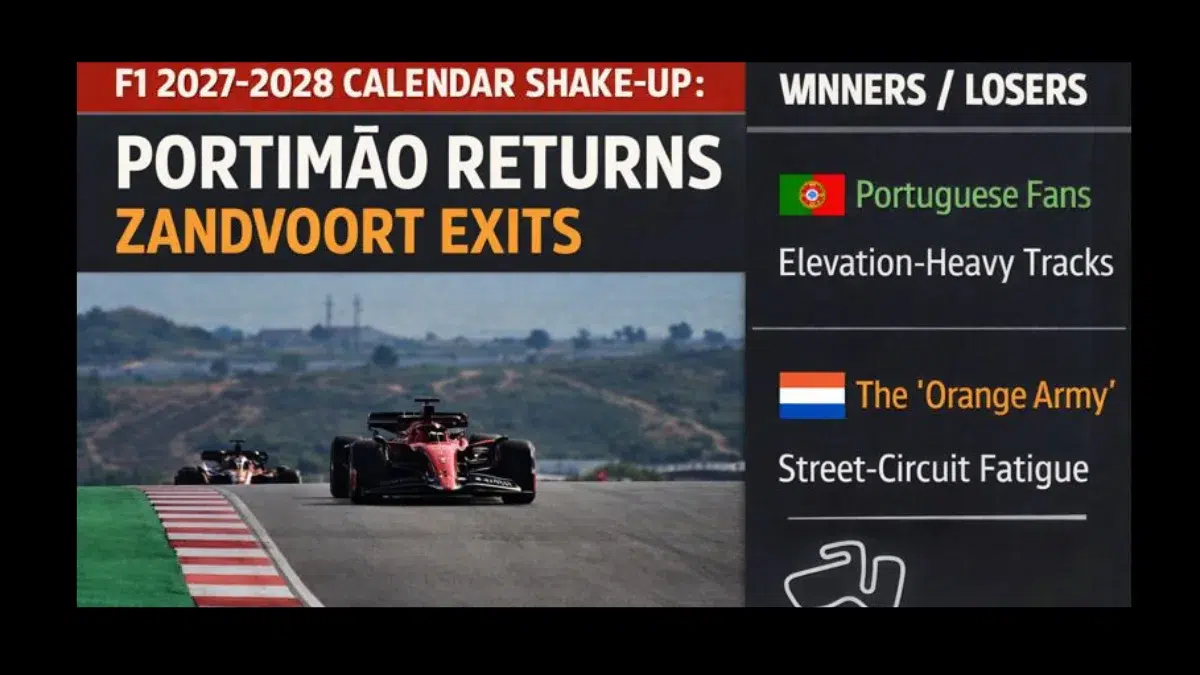
How Portimão Actually Races in Formula 1
The 2020 Portuguese Grand Prix remains the most relevant reference point. Lewis Hamilton dominated the race, winning by more than 25 seconds over Valtteri Bottas. Max Verstappen finished third, while Charles Leclerc was the only other driver not to be lapped. Several drivers were lapped twice.
While Portimão looks fast and flowing, overtaking opportunities are limited for modern Formula 1 cars. Turn 3 remains the primary passing zone, while uphill sections and cambered corners make following closely difficult. The result is racing that often feels stretched rather than intense.
This explains the mixed reaction to Portimão’s return. It is widely seen as preferable to another temporary street circuit, particularly as concerns grow around street-circuit fatigue. However, it is not considered a classic capable of consistently producing wheel-to-wheel battles.
The 2027–2028 Contract Landscape
Portimão’s inclusion must be viewed alongside broader calendar shifts. Several established venues face uncertain futures, while others are locked into long-term agreements that shape Formula 1’s geographic footprint.
| Circuit | Status |
|---|---|
| Portimão | 2027–2028 confirmed |
| Zandvoort | Out 2027–2028 |
| Barcelona | Ends after 2026 |
| Miami | Contract until 2041 |
Imola’s future remains uncertain and may depend on whether Madrid’s new circuit is ready on schedule. Meanwhile, Monza, Silverstone, Hungary, Canada, Australia, and Austin all enjoy long-term security. The result is a calendar that feels increasingly modular, with short-term deals filling gaps rather than defining eras.
Verstappen at Estoril: GT3 Racing and Questions

Away from calendar politics, Max Verstappen added intrigue by testing GT3 machinery at Estoril. He was first seen driving a Ferrari 296 GT3 before later switching to a Mercedes GT3 in damp conditions. While not an F1 test, the optics inevitably attracted attention.
Verstappen has long spoken about his love for GT racing, and Red Bull advisor Helmut Marko has previously acknowledged that such racing helps keep the world champion motivated during demanding seasons. For Verstappen, additional competition appears to be a necessity rather than a distraction.
Any suggestion that GT3 activity hints at a future Formula 1 move remains speculative. However, it reinforces Verstappen’s unique position in the sport a driver whose interests extend well beyond the traditional boundaries of Formula 1.
The Symbolism of Number 3
Observers also noted Verstappen operating from a garage marked with the number “3” reigniting speculation that he may wish to return to his original racing number. Verstappen used number 3 extensively in karting before switching to 33 in Formula 1 due to availability.
A change would require Daniel Ricciardo’s consent and FIA approval, but the symbolism is clear. A return to number 3 would represent a personal reset rather than a branding exercise.
What Comes Next for the Formula 1 Calendar?
Portimão’s return does not end the debate. Circuits such as Istanbul Park and Sepang remain popular among fans, while the push for an African Grand Prix continues. Formula 1’s challenge is balancing expansion with sustainability.
The rising costs of competition, explored in depth in our analysis of the 2025 F1 Destructor Championship costs, and the sweeping technical changes ahead, including the 2026 Formula 1 technical revolution, will further influence how the calendar evolves.
For now, Portimão represents Formula 1’s compromise: a traditional circuit without permanence, spectacle without certainty, and a reminder that the sport’s future is increasingly shaped by flexibility rather than legacy.
Fans can watch Formula 1 live on www.F1.com as the sport prepares for its next phase.