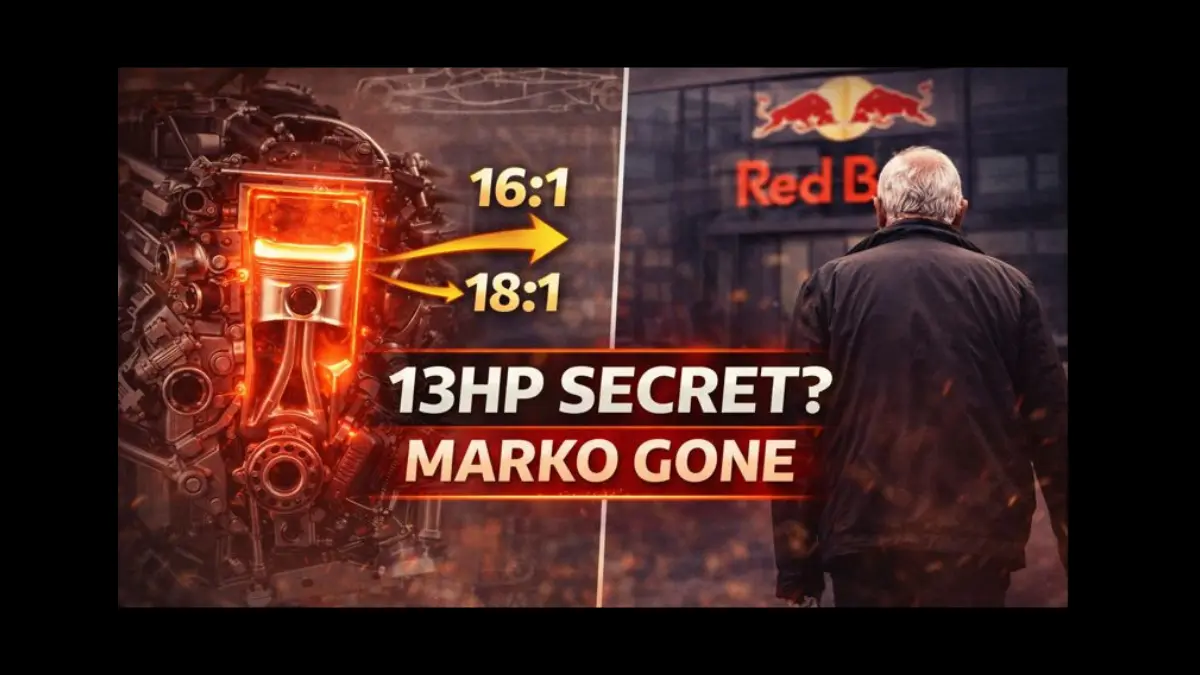
F1 2026 Engine Loophole: Mercedes Compression Trick & Helmut Marko Red Bull Exit
Formula 1’s 2026 reset was meant to usher in cost control, sustainability, and competitive convergence. Instead, the winter break has delivered an old familiar storyline: a suspected F1 2026 engine loophole, Mercedes engineering ingenuity, and political turmoil inside Red Bull Racing following the exit of Helmut Marko.
As teams prepare for the first closed door tests in Barcelona, the paddock is no longer whispering. The central question dominating technical briefings and FIA corridors is blunt: Has Mercedes already broken the 2026 engine formula?
The F1 2026 Engine Loophole: Static Rules vs Dynamic Reality
The heart of the controversy lies in how the FIA regulates engine architecture under the 2026 power unit rules. The internal combustion engine is capped at a compression ratio of 16:1, verified during inspection at ambient temperature.
However, engineers do not race engines at ambient temperature. During operation, combustion chambers routinely exceed 120°C, creating a critical distinction between what is measured and what is raced.
According to multiple paddock sources, Mercedes High Performance Powertrains may be exploiting this gap by deploying a Mercedes shape memory engine concept. The theory is simple in principle but complex in execution:
- At rest, the engine geometry complies with 16:1.
- At race temperature, thermally deforming materials expand.
- Effective compression rises toward 18:1 .
Crucially, FIA inspection protocols currently validate components in static conditions. If the engine is legal when inspected, proving non compliance during dynamic operation becomes exceptionally difficult.
Mercedes F1 2026 Engine Advantage and the Competitive Fallout
If Mercedes have indeed unlocked this advantage, the implications extend far beyond Brackley. For 2026, Mercedes will supply power units to McLaren, Williams, and Alpine, meaning nearly half the grid could benefit from the same architecture.
This concentration of power has triggered alarm bells at Ferrari, Audi, Honda, and Red Bull Powertrains. Even if the technology is eventually deemed legal, the time required to replicate it could stretch into multiple seasons.
| Team | Engine Supplier | 2026 Title Odds | Outlook |
|---|---|---|---|
| Mercedes | Mercedes | 33% | Early Favorites |
| McLaren | Mercedes | 29% | Major Beneficiary |
| Red Bull Ford | RBPT | 16% | High Risk Transition |
| Ferrari | Ferrari | 12% | Chasing Clarity |
Helmut Marko Red Bull Exit: End of an Era
While Mercedes push technical boundaries, Red Bull Racing is undergoing its most profound internal reset in two decades. Official filings confirm the Helmut Marko Red Bull exit on December 19, 2025.
Marko’s influence extended far beyond driver contracts. He was the ideological backbone of Red Bull’s ruthless, results first culture. His departure coincides with Laurent Mekies assuming control and Red Bull preparing to race its own power unit for the first time.
Verstappen’s recent remarks about lax FIA enforcement and plank wear policing suggest growing unease. Without Marko acting as internal shield and political enforcer, Red Bull face a fragile transition period.
F1 2026 Compression Ratio Debate and FIA’s Dilemma
The FIA now faces an unenviable choice. If the Mercedes compression solution is banned retroactively, four teams could be forced into emergency redesigns months before homologation deadlines.
If it is allowed, rivals may face a multi year competitive deficit eerily similar to Mercedes’ dominance following the 2014 hybrid reset.
The governing body has already tightened language around fuel flow meters, banning any system designed to alter temperature readings. Yet compression ratio regulation remains anchored to static testing.
Gasly’s Warning and the One Car Team Problem
Pierre Gasly’s recent comments have added context to Red Bull’s vulnerability. His experience in 2019 highlighted a structural reality: once championships are on the line, Red Bull often becomes a one car team.
As Red Bull Powertrains debut under pressure, that internal imbalance could prove catastrophic if Mercedes’ engine advantage materializes.
More analysis: How Ferrari, Alpine, Honda and Red Bull are responding | Official Formula 1 updates