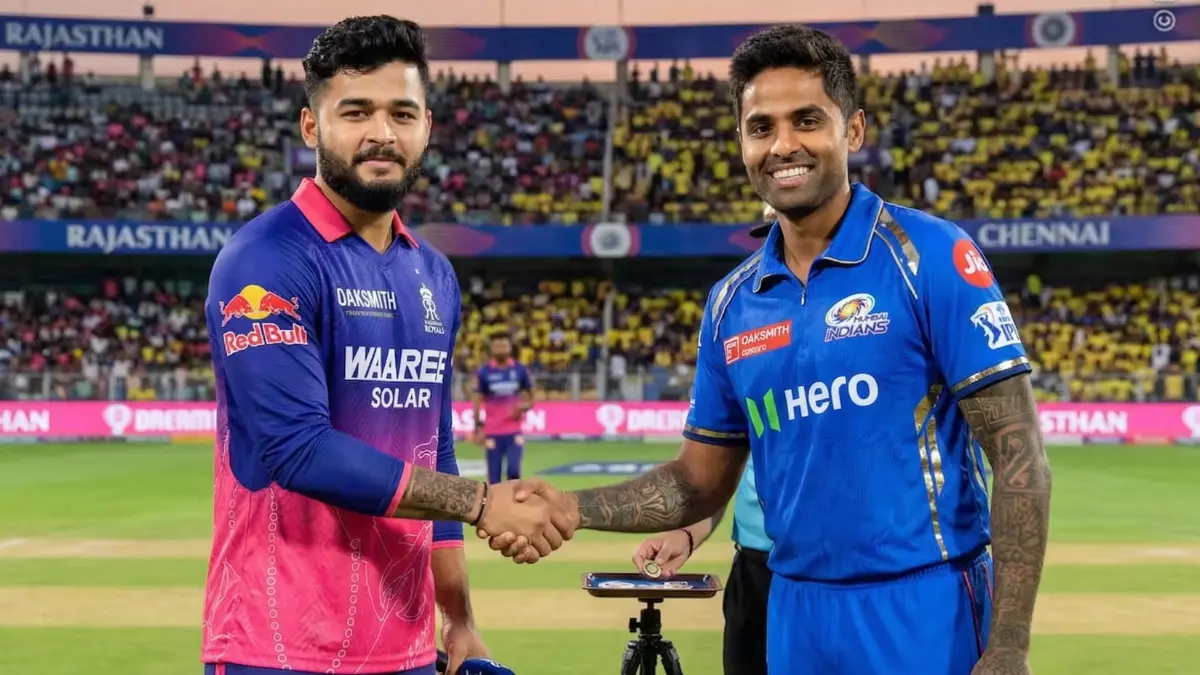
Key Takeaways
- Rajasthan are unbeaten and in great form. Securing two wins from two games including a six-run thriller against Gujarat Titans. “Sooryavanshi Factor” at the top and Ravi Bishnoi’s match-turning spin in the middle overs secured RR’s win
- Mumbai’s inconsistency has been exposed. A brilliant opening win chasing 221 against KKR was followed by a flat six-wicket loss to Delhi, where the middle-over scoring rate collapsed to just 8.29 RPO in the absence of Hardik Pandya.
- Hardik’s return provides another seam option. Without him, Mumbai have only three genuine seam options. With him, their middle-over defensive problem has been solved.
- The dew in Guwahati is a game-changer. In the recently held T20 world cup match between India and New Zealand here in January 2026 saw India chase 154 in just 10 overs. That is the advantage here when batting second, the ground becomes a batting paradise in the second innings.
- Vaibhav Sooryavanshi is the most disruptive force in IPL 2026 and will face Deepak Chahar with the new ball, a left-hander versus an inswing specialist. This battle will decide Rajasthan’s Powerplay total.
- Head-to-head since 2018: RR lead 8-6. The momentum belongs to Rajasthan in the modern era, and their home advantage at Guwahati adds another layer of confidence.
Two Franchises, Two Different Stories
Rajasthan Royals have entered IPL 2026 with a brand new identity. Sanju Samson is gone, traded to Chennai Super Kings. This was one of the off-season’s most surprising moves. In his place, the franchise has made a bold cultural bet by placing their hopes onRiyan Parag to lead the side in his home state. Fifteen-year-old Vaibhav Sooryavanshi has shown that he is one of the most aggressive opening weapons in the competition.
This is not just a rebuilding project, it is an ideological shift. Rajasthan have decided that to win T20 cricket in the modern era is to front-load their aggression, trust their young talent under pressure, and use their bowling variety to defend or set totals. Two wins into the season, it shows their philosophy is working.
Mumbai Indians arrives in Guwahati carrying the baggage of a match they should not have lost. Against Delhi in Match 8, they were without Hardik Pandya , and the effect was immediately visible. Their bowling became one-dimensional, their middle-order scoring rate dropped, and they conceded runs in clusters. It was a match that revealed how dependent this team is on their three Indian superstars Rohit, SKY, and Hardik.
Sooryavanshi Phenomenon: Why He Changes Everything
Vaibhav Sooryavanshi is only fifteen years old. He scored a 15-ball fifty against CSK in his first big match of the season. Let that number settle: 15 balls, 50 runs, against a frontline IPL bowling attack. He did not slog, he played proper cricketing shots and scored at an exceptional strike rate.
Sooryavanshi provides Rajasthan a strong opening structure. In his current form Sooryavansi can out perform opposition’s any sort of bowling plan. Rajasthan’s batting powerplay has become their one of the strongholds. Their openers are ready to take any bowler apart from ball one. This allows Yashasvi, who is one of the most technically young batters in the world to play more calculated shots. He does not need to put extra force as Sooryavanshi is already setting a platform on the other end.
Guwahati’s red soil surface, offers decent pace and bounce in the first innings and becomes a batting paradise in the second innings. Sooryavanshi’s attacking approach becomes even more valuable in such conditions. Whether Mumbai is chasing or defending their bowlers need to pick wickets early, else if Sooryavanshi gets going then it would become an impossible task.
Rajasthan’s Team: Why They Are the Early-Season Favourites
Beyond Sooryavanshi, Rajasthan’s strength lies in the layering of their squad. Every phase of the game has a primary operator and a backup:
Powerplay: Sooryavanshi destroys, Jaiswal anchors. If one fails, the other carries. This redundancy is rare in T20 opening partnerships.
Middle overs: Dhruv Jurel’s 75* against GT showed a batter of real quality at No. 3. Riyan Parag provides explosiveness in middle overs. Shimron Hetmyer’s record as a death-over force is exceptional, he regularly finds boundaries in the final overs against quality seam attacks.
Bowling: Jofra Archer’s pace (150+ km/h), Ravi Bishnoi’s leg-spin, and Ravindra Jadeja’s control form a genuinely varied three-pronged attack. Archer is particularly well-suited to Guwahati’s red-soil pitch. The pitch offers carry and bounce that makes his short-pitch deliveries and yorkers genuinely threatening.
| Match | Opponent | Result | Key Performance |
|---|---|---|---|
| Match 3 | Chennai Super Kings | Won by 8 wickets | Sooryavanshi 52 (15b); Burger 2/26 |
| Match 9 | Gujarat Titans | Won by 6 runs | Bishnoi 4/41; Jurel 75* |
Mumbai’s Problem: The Hardik Dependency and the Middle-Over Crisis
Mumbai Indians, one of the structurally deepest squads in the competition. But depth means nothing if the architecture that holds the team together is missing. Against Delhi, without Hardik Pandya, two things broke down simultaneously.
First, the bowling balance. Mumbai have three genuine seam options: Bumrah, Deepak Chahar, and Shardul Thakur. In Hardik’s absence Bumrah’s 4 over can never be utilized strategically. Hardik provides a fourth seam option that gives the captain genuine flexibility. Hardik’s presence provides an ability to keep Bumrah fresh for the death overs while using other bowlers in the middle. Without Hardik, Bumrah must bowl in multiple phases, which limits how he is used and depletes the surprise factor that makes him so effective at the death.
Second, the leadership and field-setting. Hardik is not just a player, he has an active tactical presence. His field placements, his ability to read batters in real time, and his willingness to take responsibility for the bowling changes that don’t work makes him a captain who is willing to take even tough decisions when needed. Hardik’s absence had created a vacuum which was not easy to be filled.
| Match | Middle-Over RPO | Result |
|---|---|---|
| Match 2 vs KKR (Won) | Data consistent with 11+ RPO chase | Won by chasing 221 in 19.1 overs |
| Match 8 vs DC (Lost) | 8.29 RPO (overs 7-15) | Lost by 6 wickets |
The contrast is stark. As against KKR, Mumbai’s batters scored freely throughout the chase and 221 runs were scored in just 19.1 overs. Against Delhi, the middle overs created a huge proble for Mumbai, and Sameer Rizvi’s 90 off 51 balls for DC exposed “non-perfect lengths” from Mumbai’s bowlers. If Hardik returns, both of those problems would become significantly more manageable.
Four Matchups That Will Decide Match 13
Matchup 1: Rohit Sharma vs Jofra Archer: The Opening Battle
Rohit Sharma is well known to take down any bowler without any hesitation. He will enter Match 13 in genuine form, with a season average of 39.44 and a clear plan to attack from ball one. He has shown that his approach to T20 captaincy has evolved into something more attacking since his Test retirement. Jofra Archer, clocking consistently above 150 km/h, is one of the most dangerous new-ball bowlers in the competition.
Key variable: Archer has the ability to move the ball and under Guwahati’s lights, he could prove difficult to handle when he gets going. The red-soil surface, combined with moisture in the air and high humidity (69%), should help Archer find swing in the first two overs. If Archer gets Rohit in the Powerplay as he is entirely capable of doing that then Mumbai’s base will disintegrate before it is even built.
Matchup 2: Vaibhav Sooryavanshi vs Deepak Chahar: Teenager vs Swing Specialist
This is the tactical battle Rajasthan’s camp will spend their most time on getting past the swing of Deepak Chahar. Deepak Chahar specialises in inswinging deliveries to right-handed batters and, crucially, late outswingers to left-handers. Sooryavanshi bats left-handed, so Chahar’s outswing pitching in the channel outside off stump is precisely the delivery that will create troubles for the young left-handers who play across the line.
If Chahar removes Sooryavanshi inside the first three of powerplay. The scoring rate will slow down and Mumbai’s bowlers would effectively neutralize the element that makes RR most dangerous. If Sooryavanshi survives the first ten balls and gets his eye settled in then the game changes entirely.
Matchup 3: Ravi Bishnoi vs Suryakumar Yadav: Spin vs the Complete Batter
Bishnoi’s googlies have been match-defining in both of Rajasthan’s wins this season. Four wickets against Gujarat, induced a collapse that trigger Gujarat’s middle order and shifted the momentum completely. Suryakumar Yadav is, statistically, one of the best batters in the world against leg-spin. His sweep and ramp over fine leg are strokes that explicitly target the length and line that leg-spinners rely on.
This matchup in overs 7 to 14 will set the tone for the Mumbai’s innings. If SKY can neutralise Bishnoi by scoring at 150+ SR then, Mumbai will be able to maintain their momentum. If Bishnoi beats SKY with a googly that skids through the red-soil surface then the innings collapses in the way GT’s did.
Matchup 4: Jasprit Bumrah vs Shimron Hetmyer: The Death-Overs Contest
Bumrah’s career death-over economy rate is the best of any pacer in the world. He consistently has been able to maintain his economy under 6.00 in high-scoring games. Hetmyer, meanwhile, has been Rajasthan’s most effective weapon in the final five overs since his arrival at the franchise. His ability to deposit good-length deliveries over the square-leg boundary is a strength which is not dependent on pace. This gives him a specific matchup advantage against bowlers who rely heavily on pace.
If Rajasthan are batting first then, Hetmyer versus Bumrah in overs 17-20 could play a crucial role in determining whether RR would finish at 175 or 205. That 30-run difference is often the margin between a defendable and an undefendable total on this ground.
Guwahati Factor: Home Advantage and the Dew
Rajasthan’s decision to play home matches in Guwahati is deliberate after moving out of Jaipur. The crowd noise, the humidity, and the surface characteristics all align with their new playing identity. An aggressive, fast-scoring team this benefits them from a venue where the second innings becomes progressively more easier for batters.
India vs New Zealand match in January 2026 at this venue is the clearest indicator of what match night conditions can produce. India chased 154 in just 10 overs at 15.50 RPO with the ball skidding on in the second innings batting became more easier. This kind of second-innings behaviour disproportionately favours whichever team bats second. With teams having batting line up this strong will be a crucial reason for both captains to instinctively choose to bowl first at the toss.
Head-to-Head: Modern Dominance and Historical Context
| Statistic | Rajasthan Royals | Mumbai Indians |
|---|---|---|
| Total H2H Matches | 31 | |
| Overall Wins | 14 | 16 |
| Wins Since 2018 (Modern Era) | 8 | 6 |
| Highest Team Total (H2H) | 212/7 (2023) | 217/2 (2025) |
| Most Runs (H2H) | Sanju Samson 640* | Suryakumar Yadav 472 |
| Most Wickets (H2H) | Jasprit Bumrah 19* | Jofra Archer 12 |
| 2025 Results | Won (125 defended) | Won by 100 runs |
*Samson’s tally includes RR tenure; Bumrah’s wickets were taken for MI across the rivalry.
The overall lead belongs to Mumbai 16 wins to 14. But since 2018, Rajasthan have reversed that trend, winning 8 of 14. The 2025 season perfectly illustrated the parity: RR defended 125 in one fixture, then MI won by 100 runs in the reverse. This is a rivalry where form and conditions matter more than historical records.
IPL 2026 Context: Points and Pressure
| Position | Team | Played | Won | Lost | Pts | NRR |
|---|---|---|---|---|---|---|
| 2 | Rajasthan Royals | 2 | 2 | 0 | 4 | +2.233 |
| 6 | Mumbai Indians | 2 | 1 | 1 | 2 | -0.206 |
Rajasthan sit second in the table with a healthy NRR of +2.233 reflecting their dominant win over CSK and their narrow win over GT. Mumbai are sixth, with one win and one loss, and an NRR that has slipped to -0.206. A win here for MI takes them to 4 points and puts them right back in contention; a loss drops them to 2 points from 3 games, which begins to feel like a structural problem in the context of a 14-game league stage.
Match Prediction: Form, Conditions, and the Toss
Rajasthan hold a slight edge with their current form, their home advantage is real, and their bowling attack is well-suited to the conditions. The Sooryavanshi-Jaiswal combination at the top remains the most explosive opening combination in the competition.
But this is Mumbai Indians at something close to full strength. If Hardik returns, and MI decides to play Boult and if Bumrah and boult takes early wickets, and if SKY can neutralise Bishnoi, then Mumbai possesses the ability to win anywhere, including here. The toss will be decisive, and whoever bats second in the dew will carry a structural advantage of 10-15 runs. On current form and conditions, Rajasthan are slight favourites but this match could genuinely go either way.
Editor’s Prediction
RR to win by 12-18 runs or via a tense last-over finish. Jofra Archer to be the standout bowler. Sooryavanshi to deliver a 20+ ball impact in the Powerplay. Bumrah to be Mumbai’s best hope, but Rajasthan’s batting depth ultimately prevails on a surface that rewards their style of play.